A Year of Photographers in the Picture

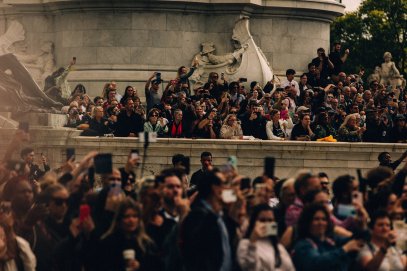
Stefan Rellandini—Reuters
Sept. 15, 2012. Pope Benedict XVI waves as he arrives on his popemobile for a meeting with youths at Bkerke in Harissa, near Beirut.

A little shy of a year ago—with the world’s attention focused on a change of power in North Korea—a photo of Kim Jung Il’s funeral, released by KCNA (North Korean Central News Agency), sparked controversy.  The image had been manipulated—less for overt political ends, more for visual harmony. The photo’s offending elements, photoshopped from the image, were not political adversaries or top secret information, but a group of photographers who had disturbed the aesthetic order of the highly orchestrated and meticulously planned occasion.

KCNA/Reuters

Dec. 28, 2011. A limousine carrying a portrait of late North Korean leader Kim Jong-il leads his funeral procession in Pyongyang.

In an age where seemingly every occasion is documented through photography from every conceivable angle—an estimated 380 billion photographs will be taken this year alone—it’s not only North Korean bureaucrats who are wrestling to keep hoards of other photographers out of their pictures.

Photographers frequently appear in news photographs made by others. Banks of cameras greet celebrities and public figures at every event; cell phones held high by admirers become a tribute in lights, but a distraction to the viewer. Amateurs and professionals, alike, appear in backgrounds and in foregrounds of images made at both orchestrated events and in more candid moments. The once-invisible professional photographer’s process has been laid bare.

On occasion, photographers even purposefully make their fellow photographers the subject of their pictures.  The most difficult picture to take, it seems, is one without the presence of another photographer either explicitly or implicitly in the frame.

Everyone wants to record their own version of reality—ironically, it turns out, because by distracting oneself with a camera, it’s easy to miss the true experience of a moment. At a recent Jack White concert, the guitarist requested that audience members stop trying to take their own photos. “The bigger idea,” his label noted in a statement, “is for people to experience the event with their own eyes and not watch an entire show through a tiny screen in their hand. We have every show photographed professionally and the pictures are available from Jack White’s website shortly after to download for free.”

The abundance of camera phones and inexpensive digital cameras has changed the photographic landscape in countless and still-incompletely understood ways, and it’s not just the North Korean government trying to find ways around the hoards of photographers making their way into everyone else’s shots. Here, TIME looks back on the past year to highlight an increasingly common phenomenon: the photographer in the picture.

Related Topics: , , , , , , , , , , , , , , , , , ,

Latest Posts

Oklahoma Tornado

Moments of Hope in Oklahoma: One Photographer’s Story

In the midst of the chaos and devastation that descended on Moore, Okla., one of the first photographers to the scene recounts the heroic moments of a community banding together.

Read More
toutSUBOTZKY_Windows - Ponte City 1

Ponte City: An Apartheid-Era High Rise Mired in Myth

Amy Toensing for The National Geographic

PJL: May 2013 (Part 2)