Three War Photographers: Feel Fear, Keep Going

Clichés are tricky things. They convey a kind of truth — but can ring hollow. They can sound profound — but once uttered, they’re utterly forgettable. And while often employed to pay tribute to an individual, or to describe a specific profession, some clichés can be applied to a litany of vocations.

When other people run away from danger, they run toward it. They go into battle armed with nothing but courage. Like everyone else, they experience fear — but unlike everyone else, they keep going.

Ultimately, though, there’s one especially odd, defining characteristic about clichés: they endure for a reason. And while some of the assertions above — about running toward danger or experiencing fear — could easily pertain to any number of pursuits, from firefighting to mountain climbing, very few occupations in the world can make those platitudes sound new and meaningful again quite like the job of war photographer.

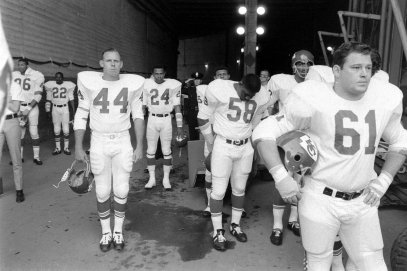
Ralph Morse—Time & Life Pictures/Getty Images

Here, in a short film by Will Wedig, Jonah Weintraub and Bill Shapiro — made to honor recipients of Time Inc’s prestigious Briton Hadden Lifetime Achievement Award — the profession and the passion of war photography, as practiced across decades by acknowledged masters, get their due.

One of the honorees, LIFE’s Ralph Morse, was sent to the Pacific in World War II as the youngest war correspondent working in that theater. All he managed to accomplish during the conflict was to survive the sinking of a cruiser off of Guadalcanal; make dozens of the most celebrated (and shocking) pictures to come out of the global conflagration; chronicle the liberation of Paris in 1944; and record the German surrender to Eisenhower in 1945. (Morse went on to so devotedly and inventively cover the early days of the Mercury Seven and the Space Race that John Glenn dubbed him the “eighth astronaut,” while LIFE’s long-time managing editor George Hunt once declared that “if LIFE could afford only one photographer, it would have to be Ralph Morse.”)

Larry Burrows—Time & Life Pictures/Getty Images

The late, British-born Larry Burrows distinguished himself covering Southeast Asia from 1962 until his death in 1971. His work, from the searing single image, “Reaching Out” (featuring a wounded Marine desperately trying to comfort a stricken comrade after a fierce 1966 firefight in a landscape that might have given Hieronymus Bosch nightmares) to his great photo essay, “One Ride With Yankee Papa 13,” not only captured the war in Vietnam. For millions of people around the world, Burrows’ pictures encompassed and defined the long, divisive catastrophe.

He and three fellow photojournalists died when their helicopter was shot down during operations in Laos. Larry Burrows was 44.

James Nachtwey for TIME

Finally, there’s James Nachtwey, who has covered civil strife, natural disasters and armed conflicts around the globe for more than three decades. He has seen fellow photographers and friends injured and killed while doing their jobs. He has been wounded himself (in Iraq in 2003, when an insurgent tossed a grenade into a Humvee that he and TIME’s Michael Weisskopf were riding in). He was the subject of the 2001 Oscar-nominated documentary, War Photographer, and is widely regarded as the greatest living photojournalist.

“To see life,” Henry Luce wrote in his now-famous 1936 mission statement for LIFE magazine, delineating what he envisioned as his new venture’s workmanlike method and its lofty aims. “To see the world; to eyewitness great events … to see strange things — machines, armies, multitudes … to see and be amazed; to see and be instructed.”

Across decades, Morse, Burrows and Nachtwey have seen, and have helped us see, the very best and the absolute worst that humanity can offer.

When other people ran from danger, they ran toward it. They went into battle armed with nothing but courage. They experienced fear — and they kept going. These are war photographers.

Ben Cosgrove is the editor of LIFE.com.

Related Topics: , , , ,

Latest Posts

Steve Ruark—AP

Honoring the Fallen: One Photographer’s Witness to 490 Dignified Transfers

Since April 2009, the Associated Press has sent a still photographer to every dignified transfer of servicemen and women killed in Iraq or Afghanistan open to the media. Most often it is freelancer Steve Ruark. To mark Memorial Day, TIME presents a gallery of the almost 500 transfers he has attended since 2009.

Read More
US-WEATHER-TORNADO

Pictures of the Week: May 17 – May 24

Saudi citizens rest after presenting Saudi Billionaire HRH Prince al Waleed bin Talal with petitions for his help at a desert camp outside of Riyadh, in Saudi Arabia, February 27, 2013.   Like many families across Saudi Arabia who are barely scraping above the poverty line each month, many poor Saudis rely on the hope of the charity of others to survive. (Credit: Lynsey Addario/ VII)

Rich Nation, Poor People: Saudi Arabia by Lynsey Addario