‘Home Works’ by Joakim Eskildsen

Joakim Eskildsen
Joakim Eskildsen
Home I
Kyrkslätt, Finland

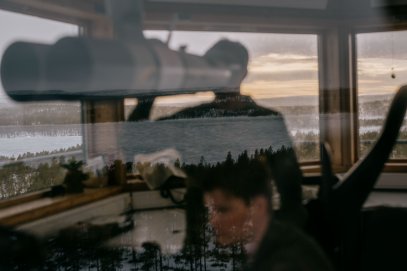
Joakim Eskildsen’s new body of work, Home Works, explores the poetry of place through the five different homes to which he has moved his family over the past six years. His pictures are painter-like, discovering different moods and seasons, a quiet thoughtfulness, an overwhelming beauty and a love of landscape. His family’s final move to a new home in Germany, just this month, will dictate the last pictures in the project.

The series began in 2005, just before his son Seraphin was born. Two years later, his daughter Rubina was born. “The whole process of having children is such an interesting thing,” he says. “They have been very inspiring to follow, and to discover the world and landscapes together with.” The landscapes are often empty but sometimes dotted with a child. In the early pictures, the children are small elements in the larger frame and as the work moves forward through time, the children take precedence over their surroundings.

One of the most exciting aspects of Eskildsen’s process is the influence that bookmaking has had on his direction. Since the beginning of his career he has integrated the bookmaking form directly into his photography process.

As an MA student in Finland, he studied with Finnish masters, Pentti Sammallahti and Jyrki Parantainen. Under their mentorship he was amazed to discover the idea that the photographer could be in charge of the whole process of making the book: from layout to typography to binding to offset printing: “The main idea was that the book itself is the art object, and not a catalog for the exhibition prints.“

Over the next four years as an MA student, Eskildsen made his first two books by hand: Nordic Signs and Bluetide. After school he published iChickenMoon with an edition of 1,800. Most recently, The Roma Journeys—his brilliant book about the European ethnic groups known as Gypsies—was published by Steidl in 2007. “The book is a very flexible format. You can work on only one book or you can print it in an edition of 11,000. Both can be equally inspiring,” he says. “There is something in this whole process which is so magical and keeps challenging me.”

Those formative years in Finland inspired a slow and thoughtful approach to his work. “I like to allow myself to work over a span of years to have a kind of relationship with the work,” he says. “I feel almost that if it is too fast, you might not get to know the pictures before it’s over.” In Home Works in particular, Eskildsen is working very closely in tandem between making the pictures and then taking time to work on layouts and juxtapositions, and to re-edit and refine and then to continue shooting. He plans to give himself two more years to capture his newest home. In this process, he says, “the vision becomes clearer”: “One of the main things I learned is that the work is only half done when you have a lot of good pictures,” he says. “One has to spend a lot of time with these images, too, and work a lot with them.”

Eskildsen’s diligence is being recognized. Steidl plans to publish Home Works in 2015, along with American Realities—about poverty in America (a project originally commissioned for this magazine)—and a third edition of Roma Journeys, both planned for 2013, as well as a re-print of Nordic Signs for 2015.

Joakim Eskildsen is a Danish photographer based in Berlin. He is best known for his book The Roma Journeys (Steidl, 2007). More of his work can be seen here.

Related Topics: , , , , , , , ,

Latest Posts

Saudi citizens rest after presenting Saudi Billionaire HRH Prince al Waleed bin Talal with petitions for his help at a desert camp outside of Riyadh, in Saudi Arabia, February 27, 2013.   Like many families across Saudi Arabia who are barely scraping above the poverty line each month, many poor Saudis rely on the hope of the charity of others to survive. (Credit: Lynsey Addario/ VII)

Rich Nation, Poor People: Saudi Arabia by Lynsey Addario

With its vast oil wealth, Saudi Arabia has one of the highest concentrations of super rich households in the world. But an estimated 20 percent of the population, if not more, lives in crippling poverty.

Read More
USA. Illinois. Chicago. 1948. An alley between overcrowded tenements, with garbage thrown over the railings of the back porches. Most of the area's tenants were transient. Contact email:New York : photography@magnumphotos.comParis : magnum@magnumphotos.frLondon : magnum@magnumphotos.co.ukTokyo : tokyo@magnumphotos.co.jpContact phones:New York : +1 212 929 6000Paris: + 33 1 53 42 50 00London: + 44 20 7490 1771Tokyo: + 81 3 3219 0771Image URL:http://www.magnumphotos.com/Archive/C.aspx?VP3=ViewBox_VPage&IID=2S5RYDI201Y8&CT=Image&IT=ZoomImage01_VForm

In Memoriam: Wayne Miller (1918 – 2013)

Michael Ackerman—Agence VU/Aurora Photos

Darkness Visible: On World Goth Day, Photos of Romance and Shadow