‘Dark Tourism’: Ambroise Tézenas and the Pull of Death

Ambroise Tézenas courtesy Galerie Mélanie Rio
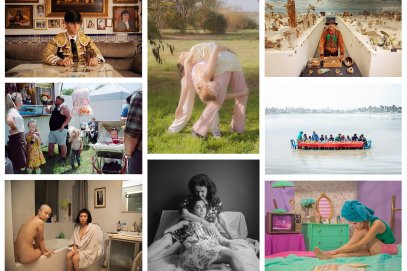
Sichuan Wenchuan earthquake ruins tour – China. 2009.

Visitors in front of Xuankou middle school, where over 53 died, and Xuankou grade school, where about 250 died.

It’s not unusual for photojournalists to travel to places that have been scarred by genocide, accident and natural disaster. But photographer Ambroise Tézenas has spent the last few years turning that norm on its head to capture what happens to those sites after the journalists leave, when they become tourist destinations.

In 2008, Tézenas was looking for his next photographic project when he read that a train, swept into the Sri Lankan jungle by a tsunami, was still there four years after the fact. Tézenas happened to have been in Sri Lanka at the time of the storm—on a vacation that became a job—and was fascinated to learn that the train had become a place of pilgrimage.

“Some tourists were coming to have their pictures taken there,” the photographer says. “I thought about what the victims and the survivors would think.”

That question became the seed of a long-term project, Dark Tourism, now on view at Galerie Mélanie Rio in Nantes, France. Tézenas immersed himself in the tourist experience: he always traveled with a tour group, always paid for the experience and only took pictures of things any tourist could see. Sometimes that ethos meant his pictures were restrained—he only had the time allotted by the tourism groups, so he was unable to wait for ideal light—but it also allowed the photographer to comment on more than the scenery.

“It wasn’t just to find new places nobody had seen,” says Tézenas, “but to link these places and to have a portrait of a new tendency of tourism.”

Not that so-called “dark tourism” is new. Professor John Lennon of Glasgow Caledonian University, who coined the term in 1996 and whose work influenced Tézenas’ project, says that the urge to turn the tourist’s gaze on horror—what Lennon calls the “pull factor” of the macabre—dates back to the spectators at the Battle of Waterloo, and further than that, to the first people who watched crucifixions as spectacle.

“It’s a human fascination with our ability to do evil, a human fascination with death,” he explains. “It’s so unimaginably terrible but it exerts this fascination.” Survey data has shown him that the impulse comes from a cross between genuine interest in history, voyeurism and, especially in recent years, commoditization, the kind of pre-packaged deals of which Tézenas availed himself. That ease of access is, according to Lennon, the new factor in the equation.

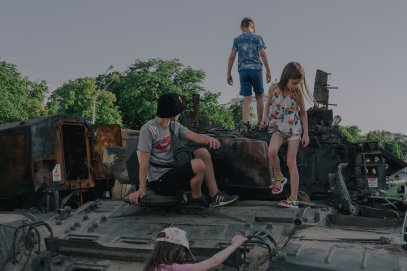
Tézenas saw that commercialization in action at a Latvian jail where tourists could pay to play prisoner and be terrorized by guards in the middle of the night, on a guided visit to Chernobyl and on a “genocide tour” of Rwanda. Lennon points out that “visiting sites of genocide doesn’t prevent genocide from happening again” and that certain gift shops can make visitors queasy, but tourism can benefit economies that are still recovering from disaster.

And, for Tézenas, it was a subject that was ripe for exploration. “In our time, we are so close to death through news and cinema and video games, but at the same time death is so removed from our contemporary society,” he says, explaining that he hoped to use photography to get to the root of the sociological phenomenon. “I want to raise the point, very humbly, because there are so many questions.”

Dark Tourism will be on view at Galerie Mélanie Rio in Nantes, France, through May 12. Ambroise Tézenas is a French photographer. See more of his work here.

Related Topics: , , , , ,

Latest Posts

Saudi citizens rest after presenting Saudi Billionaire HRH Prince al Waleed bin Talal with petitions for his help at a desert camp outside of Riyadh, in Saudi Arabia, February 27, 2013.   Like many families across Saudi Arabia who are barely scraping above the poverty line each month, many poor Saudis rely on the hope of the charity of others to survive. (Credit: Lynsey Addario/ VII)

Rich Nation, Poor People: Saudi Arabia by Lynsey Addario

With its vast oil wealth, Saudi Arabia has one of the highest concentrations of super rich households in the world. But an estimated 20 percent of the population, if not more, lives in crippling poverty.

Read More
USA. Illinois. Chicago. 1948. An alley between overcrowded tenements, with garbage thrown over the railings of the back porches. Most of the area's tenants were transient. Contact email:New York : photography@magnumphotos.comParis : magnum@magnumphotos.frLondon : magnum@magnumphotos.co.ukTokyo : tokyo@magnumphotos.co.jpContact phones:New York : +1 212 929 6000Paris: + 33 1 53 42 50 00London: + 44 20 7490 1771Tokyo: + 81 3 3219 0771Image URL:http://www.magnumphotos.com/Archive/C.aspx?VP3=ViewBox_VPage&IID=2S5RYDI201Y8&CT=Image&IT=ZoomImage01_VForm

In Memoriam: Wayne Miller (1918 – 2013)

Michael Ackerman—Agence VU/Aurora Photos

Darkness Visible: On World Goth Day, Photos of Romance and Shadow