Rawiya: Photography Collective Finds Strength in Numbers

Tanya Habjouqa
Tanya Habjouqa
Tanya Habjouqa's recent work documents the everyday lives of Palestinian women in the Gaza Strip. Here, young women exercise in gym class at their school, where the Women's Charitable Society helps organize activities for them in Gaza, Oct. 28, 2009.

Of the myriad lessons that can be gleaned from the Arab Spring, perhaps the most inspirational is the confirmation that there’s strength in numbers. So it’s hardly a surprise that several photographers who’ve made their livelihood documenting the Middle East – including the aftermath of the revolutionary riots from earlier this year – would apply such a lesson to their work.

Hence, the Rawiya collective, a photography cooperative made up of six female photographers from across the Middle East, who’ve pooled their resources, contacts and talents to not only strengthen their work, but to also expand their reach.

The photographers—Tamara Abdul Hadi (currently in Beirut), Laura Boushnak (currently in Sarajevo), Tanya Habjouqa (currently in East Jerusalem), Dalia Khamissy (currently in Beirut), Newsha Tavakolian (currently in Tehran) and Myriam Abdelaziz (currently in Cairo) – had each previously built careers shooting across the region, working the hard news cycles for various publications. However, the women felt that important social and political stories were still going unseen and wanted a platform to share them.

So when Tavakolian first approached Abdul Hadi and Khamissy during a trip to Beirut in 2009 with the idea of forming the collective, the women were enthusiastic. Boushnak and Habjouqa were asked to join the group soon after and in August 2011, Abdelaziz, whose work covering the Egyptian revolutions was admired by the other women, also joined the collective. The women spent long nights in Beirut cafes and chatting over Skype, discussing their vision.

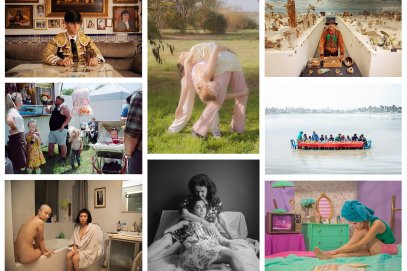
The focus of Rawiya – which means “she who tells a story” in Arabic – is on capturing the region’s social and political issues as well as its stereotypes through photo essays and long-term projects. Unsurprisingly, this has translated into a body of work that spans the spectrum of subjects from dancers to displaced citizens to drag queens. The images are powerful and, thanks to the already extending reach of the group, now garnering an audience.

Rawiya made its official debut at the Format Festival in Derby, U.K. this March and the women say they’ve already benefited from exhibiting as a group. They went on to showcase their work at the Empty Quarter Gallery in Beirut, which led to invitations to exhibit in Greece and Kuwait. Because each woman brings a new region and issue to the collective table, they all benefit from one another’s audience.

In addition, being the first cooperative of its kind from the Middle East – with only female photographers – has provided the women with an extra bump in prominence. Of course, being female in a male-dominant industry isn’t without its challenges, yet the women insist that their gender hasn’t hindered their work. “When people ask me if it is more challenging being a female photographer in this region than a male photographer I usually answer ‘no,’” Abdul Hadi told TIME in an email. “I personally have had access to places a male photographer wouldn’t, which ends up being more of an advantage.”

The women hope to capitalize on that advantage and have plans to eventually expand the collective, hoping to work with other female photographers from across the region whose work they admire. Because that’s another way the collective has strengthened one another’s work: by inspiring it.

Read more about Rawiya here.

Megan Gibson is a reporter at the London bureau of TIME. Find her on Twitter at @MeganJGibson. You can also continue the discussion on TIME’s Facebook page and on Twitter at @TIME.

Related Topics: , , , , , , , ,

Latest Posts

Saudi citizens rest after presenting Saudi Billionaire HRH Prince al Waleed bin Talal with petitions for his help at a desert camp outside of Riyadh, in Saudi Arabia, February 27, 2013.   Like many families across Saudi Arabia who are barely scraping above the poverty line each month, many poor Saudis rely on the hope of the charity of others to survive. (Credit: Lynsey Addario/ VII)

Rich Nation, Poor People: Saudi Arabia by Lynsey Addario

With its vast oil wealth, Saudi Arabia has one of the highest concentrations of super rich households in the world. But an estimated 20 percent of the population, if not more, lives in crippling poverty.

Read More
USA. Illinois. Chicago. 1948. An alley between overcrowded tenements, with garbage thrown over the railings of the back porches. Most of the area's tenants were transient. Contact email:New York : photography@magnumphotos.comParis : magnum@magnumphotos.frLondon : magnum@magnumphotos.co.ukTokyo : tokyo@magnumphotos.co.jpContact phones:New York : +1 212 929 6000Paris: + 33 1 53 42 50 00London: + 44 20 7490 1771Tokyo: + 81 3 3219 0771Image URL:http://www.magnumphotos.com/Archive/C.aspx?VP3=ViewBox_VPage&IID=2S5RYDI201Y8&CT=Image&IT=ZoomImage01_VForm

In Memoriam: Wayne Miller (1918 – 2013)

Michael Ackerman—Agence VU/Aurora Photos

Darkness Visible: On World Goth Day, Photos of Romance and Shadow