Sociology and Vantage Point: A study of Leisure Territories

Patrick Smith
Patrick Smith
Biarritz, France, 2010

Patrick Smith is represented in New York by James Danziger Projects, and will be present at the Paris Photo next November. Here he writes for LightBox on his latest project Leisure Territories.

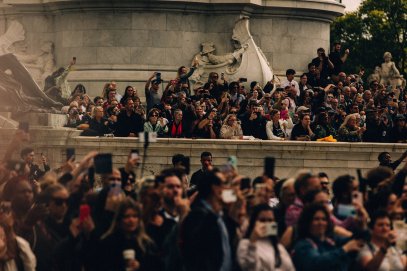
When I was a young boy, my parents lived in a small apartment, on the second floor, above a dead-end leading to a factory entrance. The factory was huge, several thousand men worked there. Almost every day, as I returned from school, I would sit precariously on the windowsill and observe the ballet of men going home after the day’s work.

That image never left me—the high vantage point, the particular space, which I compared to a stage in a theater, my observation of the interactions between the fellow workers. These memories sprung back to mind when I started the Leisure Territories project. The space, the crowd, the vantage point—it was all there.

In his Manifeste du Surréalisme, André Breton writes on the subject of the image:

“It is, from the fortuitous juxtaposition of the two terms that a particular light springs, the light of the image, to which we are infinitely sensitive. The value of the image depends upon the beauty of the spark obtained; it is, consequently, a function of the difference of potential between the two conductors. When the difference exists only slightly, as in a comparison, the spark is lacking.”

I am not adept of the surrealist thesis. I am, however a keen reader of poetry, especially the type written by flaneurs such as Baudelaire. Walking, wandering, meandering, my photography is always shot in the open. Taking in the space is a form of breathing, and looking for the spark, my aim. I am interested by the mundane, not the spectacular, and how photography may transform it.

In this text, Breton exposes the idea that the spark is triggered when two images, both sufficiently strong and distant, meet. In my photographs, I juxtapose grounds which would be barren, had not the travel industry existed (beaches, and mountains, unsuitable for building houses or harbors, or crops or livestock rearing) with the bustling realities of tourism. These areas become overpopulated, at specific periods of the year by leisure activity. I am not denouncing such activity, nor am I interested by the mass effects per se. I revel in documenting the small stories that take place between families or small groups. When the large prints are made, for exhibition purposes, this is what I look for when I approach my photographs with a new eye.


Related Topics: , ,

Latest Posts

Saudi citizens rest after presenting Saudi Billionaire HRH Prince al Waleed bin Talal with petitions for his help at a desert camp outside of Riyadh, in Saudi Arabia, February 27, 2013.   Like many families across Saudi Arabia who are barely scraping above the poverty line each month, many poor Saudis rely on the hope of the charity of others to survive. (Credit: Lynsey Addario/ VII)

Rich Nation, Poor People: Saudi Arabia by Lynsey Addario

With its vast oil wealth, Saudi Arabia has one of the highest concentrations of super rich households in the world. But an estimated 20 percent of the population, if not more, lives in crippling poverty.

Read More
USA. Illinois. Chicago. 1948. An alley between overcrowded tenements, with garbage thrown over the railings of the back porches. Most of the area's tenants were transient. Contact email:New York : photography@magnumphotos.comParis : magnum@magnumphotos.frLondon : magnum@magnumphotos.co.ukTokyo : tokyo@magnumphotos.co.jpContact phones:New York : +1 212 929 6000Paris: + 33 1 53 42 50 00London: + 44 20 7490 1771Tokyo: + 81 3 3219 0771Image URL:http://www.magnumphotos.com/Archive/C.aspx?VP3=ViewBox_VPage&IID=2S5RYDI201Y8&CT=Image&IT=ZoomImage01_VForm

In Memoriam: Wayne Miller (1918 – 2013)

Michael Ackerman—Agence VU/Aurora Photos

Darkness Visible: On World Goth Day, Photos of Romance and Shadow